
Tortoise Handling and Encounters
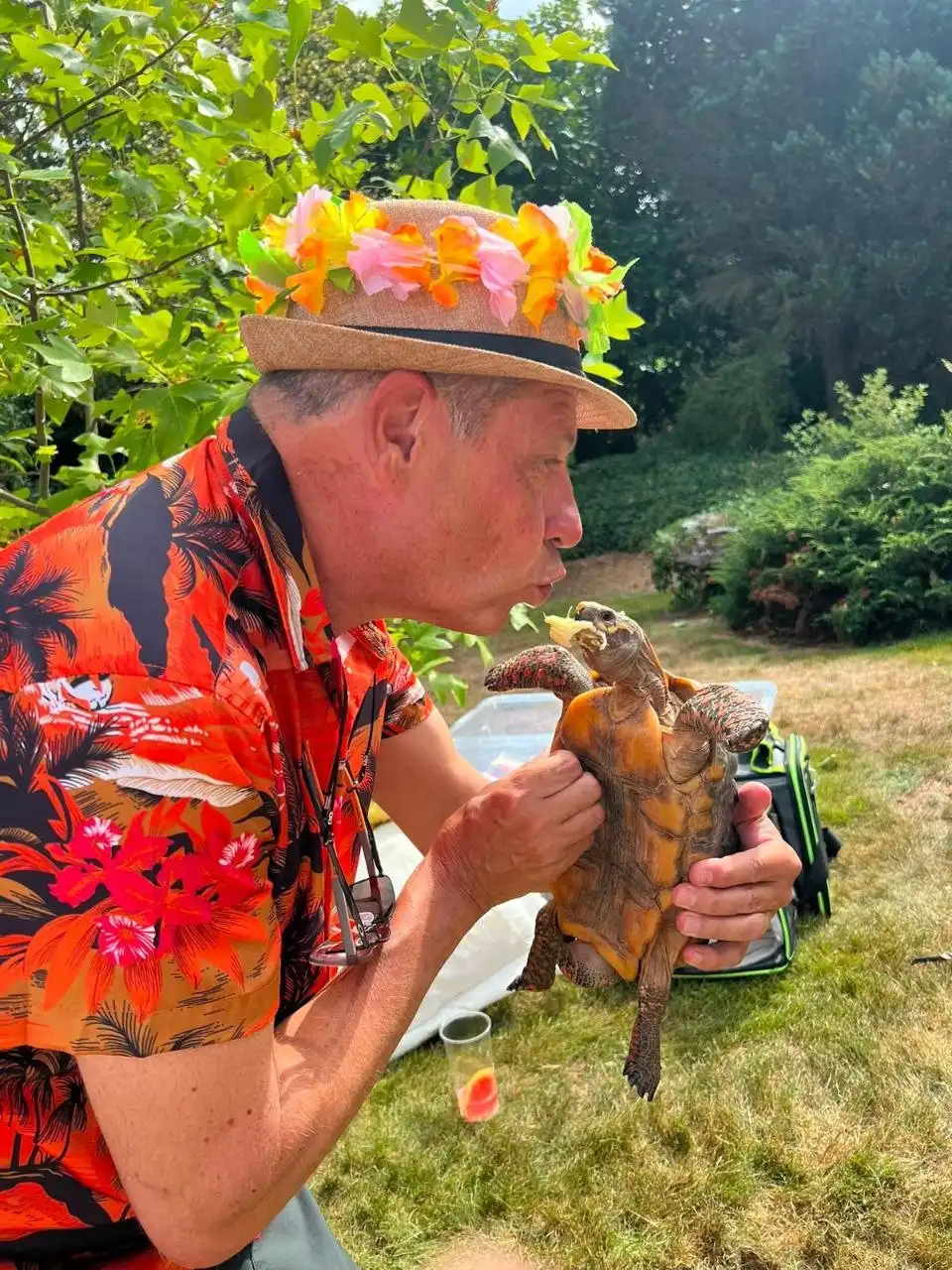
For those tortoise obsessed reptile enthusiasts, it is possible to only have tortoises come to visit. I own 7 tortoises, which include 3 different species. The encounter would include feeding of all the different types and probably a shallow paddling pool or long plastic tub of water so they can all have a bath.
Tortoises do tend to be a bit messy, no matter how many times I wash and bathe them before I leave for an event, so if your encounter or handling experience is not outside, I can bring a large tarpaulin to protect the floor from potential messes!
Tortoises don’t tend to stay still and sit on laps and if they get lifted up too high off the ground, they can expel some water (it's not really urine, which I’ll explain shortly).
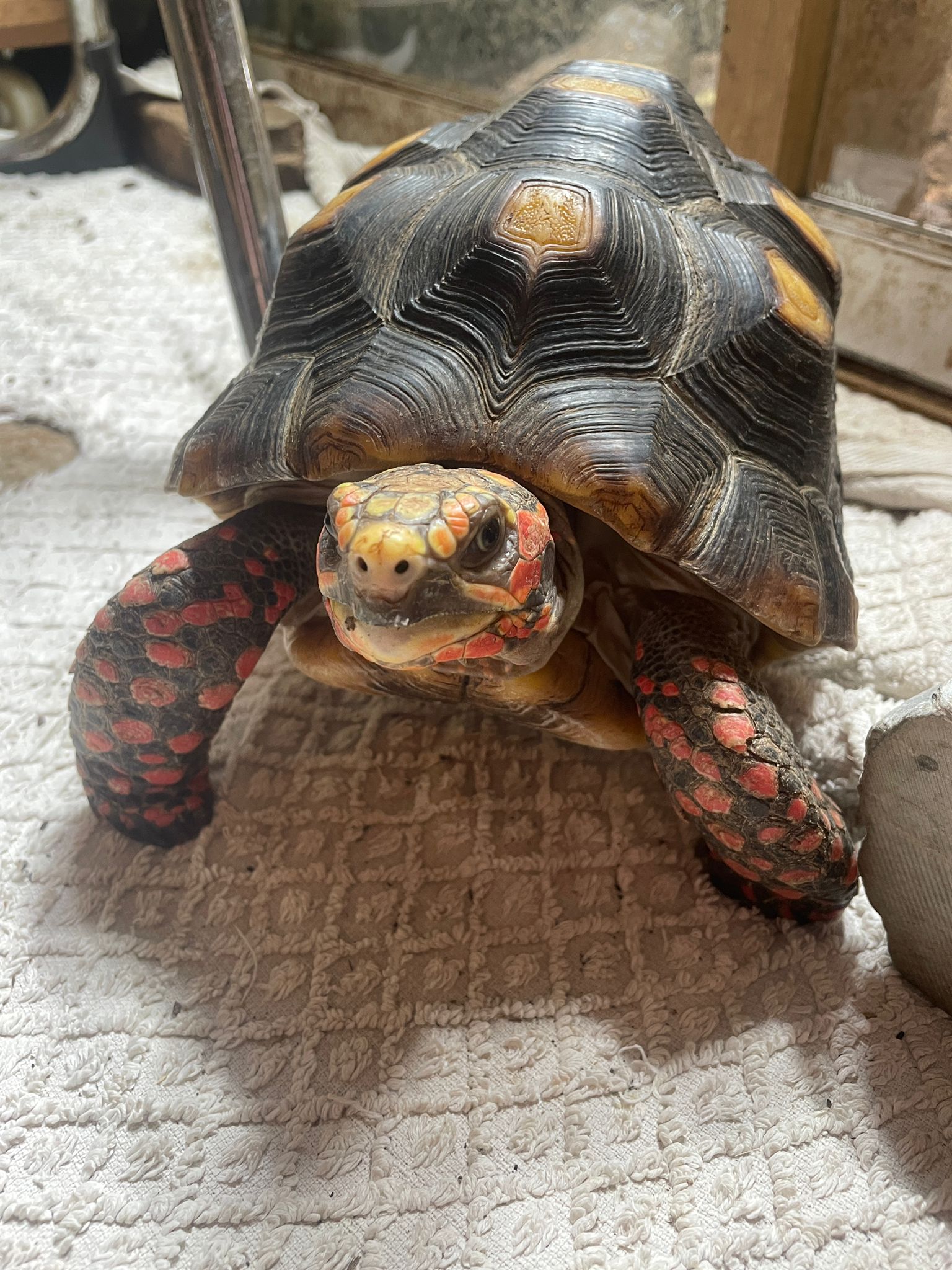
SOUTH AMERICAN RED FOOT TORTOISES
These group-living large tortoises from the amazon and other South American rainforest areas are curious tortoises that would usually move around cohabiting happily together, which is unusual for most species of tortoise. Due to living on the equator they do not hibernate and so don’t live quite as long as their hibernating relations - ‘only’ around 85 years instead of potentially 150 years! They are super hardy and eat pretty much anything - all kinds of plants and types of fruit as well as, surprisingly, meat! In their native environment they would most likely feed on the carcasses of dead animals, thus helping ‘clean up’ the floor of the jungle. In captivity it is important to give them occasional meat in their diet, more often than not this is defrosted rodents and defrosted chicks. They are excellent food ‘dustbins’, eating any uneaten snake food or even slightly off or mouldy fruit like strawberries that their owners don’t want to consume! As with all tortoises, there are plenty of weeds and wild plants and flowers in the UK to enable these guys to eat relatively cheaply. They LOVE dandelion flowers, which I will bring to feed if available. Due to time constraints (and convenience!) I usually bring a bag of mixed salad and maybe a banana for these tortoises to eat during the encounter. They eat a surprisingly large amount and also surprisingly quickly! I own 4 red foot tortoises, 2 of which were rescues, although I usually only take the biggest pair to mixed reptile events, I can bring the whole group with me to a tortoise only encounter.
On arrival, it’s is very likely that these tortoises will need a quick rinse, either in a sink or with an outdoor hose - maybe my driving makes them nervous! It is important for smaller children to watch their fingers if they try to feed the tortoises as they might mistake any fingers as tasty food and can accidentally nip. It has happened once before, no fingers were missing at the end of the party, but the owner of the finger got a surprise and needed to put her hand under some cool water - no broken skin, just a shock. They have been known to try to bite my bare feet when I’m in the reptile room feeding other reptiles - I think they like the red toe nail polish…so I’d recommend socks are kept on!
NORTH AMERICAN BOX TURTLES
Although named ‘turtles’ these guys are more similar to the red foot tortoises in their food and environmental requirements, as such, mine live together with the red foots. ‘Mr & Mrs Scooter’ are a small but very feisty and active pair. The male and female are easy to tell apart as they are very obviously sexually dimorphic, meaning they look completely different. Mrs Scooter is bigger, with a smooth, pale brown shell and Mr Scooter is much smaller with a darker, mottled patterned shell. When he is looking his best he has bright red eyes and slightly blue legs. He is extremely ‘romantic’ and has been known to make ‘romantic advances’ towards his partner at highly inappropriate occasions - she sometimes deliberately closes her shell on his feet leaving him ‘trapped’ behind her (you have been warned!) Box turtles are distinct in that they have a kind of ‘hinge’ in the underneath plate of their shell which enables them to totally seal up their body inside their shell to protect from predation. In reality, they are pretty fast and whizz about exploring everywhere, in particular, Mr Scooter, hence the name!
North American box turtles are omnivorous and will enthusiastically eat everything the red foot tortoises consume, as well as insects. They will literally chase down a morio worm and carry it off to eat, so as these insects don’t escape too quickly, I tend to bring a few morioworms with me to feed these guys so people can watch this interesting behaviour. Mrs Scooter is very docile, but Mr Scooter does have a tendency to be a bit nippy and even though his head and mouth are tiny, he can give quite a sharp bite if you’re not paying attention, however I do find providing food is a good way to prevent this by offering an alternative meat source!!
RUSSIAN HORSFIELDS TORTOISE
Horsfields or Russian tortoises are found all over northern and eastern Europe and parts of Russia, they are super hardy and seem to have several regional subspecies that look different - a large, round shaped light yellow shell with black dots, a smaller, greenish mottled shell colour and a medium sized yellow shell, which is the type that I personally own. These tortoises do not live in groups like the red foots tortoises, in fact the males would wander around on their own until they either encounter another male - in which case they'd likely bash shells together in a sort of fight until one submits - or they find a female to mate with. Once they mate, the male doesn’t hang around to help out with any nursing duties or provide any companionship! In fact, these guys can literally be a bit of a randy pest. I have known male horsefields tortoises to even pester huge female sulcata tortoises, many times bigger than themselves - even though the bigger tortoise showed zero interest, the tiny Russian tortoise still behaved like he was in with a chance! My tortoise was rescued as he had a slight mouth deformity, his bottom jaw sticks out slightly. This doesn’t seem to hinder him in any way. He eats a variety of salad leaves and healthy weeds and lives separately from the other tortoises, although he is fine to hang out with them for short, supervised periods, such as tortoises encounters. He is active and kind of cute and the least likely to nip and the most likely to tolerate a cuddle in a lap.
TORTOISE HANDLING SESSIONS EXTRA INFORMATION & FAQS
CAN WE FEED THE TORTOISES?
Yes, all of the tortoises can be fed, although they eat different foods. The red foot tortoises will eat salad, fruit and dandelion flowers (if available). I will bring salad and maybe a banana with me to feed them. The box turtles will eat fruit and salad but also insects, I will bring morioworms with me in order to feed them. Lastly, the Horsfields/Russian tortoise will eat salad, which I will provide. All will eat dandelion flowers if there is any available.
CAN THE TORTOISES BITE?
Technically, all tortoises have a kind of beak, which they use to eat food. The large red foot tortoises are able to eat the bones of small rodents and the legs and beaks of small chicks and birds, leaving no evidence. The tortoises can nip, although I try to negate the chances of them doing so by making sure most guests are wearing socks or shoes and by providing food for the tortoises to eat instead. Its most likely to occur by mistake if small fingers accidentally get in the way when the tortoises are eating salad. Most tortoises usually give a warning nose ‘bump’ before trying to bite anything and so in the rare instance that you miss this warning and a tortoise does nip, any wound is likely to be very small and a good wash with soapy water and maybe a plaster will be all that is necessary.
CAN WE TAKE PHOTOS?
YES! Taking as many photos as you like is encouraged. Particularly, photos of Mr or Mrs Scooter eating bugs are likely to provide an unusual experience or a funny photo.